

Interview with Denise Da Costa on and the walls came down
In her first novel and the walls came down, Denise Da Costa tells the story of Delia, the adolescent daughter of middle-class Jamaican immigrants. When her parents separate, Delia, her mother and her sister, move into the dilapidated Don Mount housing project in Toronto. It is already slated for demolition. This slide down the social ladder turns Delia’s mother abusive and unstable. Delia comes of age, learning to navigate a rough environment and figuring out a new definition of home.

Donna Bailey Nurse: I very much enjoyed your book. It is well-crafted and such a Toronto novel. You must be pleased it was longlisted for the Toronto Book Awards.
Denise Da Costa: Yes! That was a surprise. I suppose all awards are surprises. But as a debut author you understand that you are swimming in a pool of many fish. I’m glad it resonated.
DBN: The story belongs to Delia. But it is also very much about the difficult relationship between Delia and her mother. Can you give us a synopsis?
DD: The story begins when Delia returns to her childhood home at Don Mount housing project to retrieve her diary. The purpose of this is to uncover with an adult lens the things she saw, the feelings she had and the people she experienced as a child. Delia is especially focused on her relationship with her mother and how she was able to process her mother’s mental illness.
DBN: The mother Aretha is enigmatic. She embodies qualities found in Jamaican women of a particular class and the aspirations they hold upon coming to Canada. Can we talk about that?
DD: Yes, gladly. I don’t know how others see it. But I know what my mother taught me about what people see when they look at us. I saw how she carried herself. As much as the story is fiction, my mother, her sisters and my grandmother provided the foundation for Aretha’s character. If they had a motto, it was no matter your income, no matter where you live or your status, there is a way you must carry yourself to circumvent the continuous exterior influences on your character. Wherever you go, people are going to tell you who you are.
DD: The idea that Aretha is trying to fight is gender inequality, gender roles in her household; how she operates with her sexuality; how she operates as a mother; how she operates as a spouse. She is continually fighting against the patriarchal forces that tell her what a Black woman is supposed to be and what an immigrant is supposed to want. She is acutely aware of her place in society. Everything she does is in contradiction to that.

Author Denise Da Costa
DBN: There comes a moment in life when a young woman comes into her own and tensions may develop between mother and daughter. Aretha vociferously asserts herself against this younger woman coming up in her home, namely Delia.
DD: That dynamic is fascinating to me. I am specifically interested in points of change. And how difficult it is to pin-point, points of change. You often hear people say, “She was so nice, but then…” Adolescence marks that moment of change in some households.
DBN: At some point, all daughters require independence from their mothers. But Aretha resists this natural evolution and quite frankly, so do many of the Jamaican women I know. Why do you think this dynamic is prevalent in our community?
DD: That is an interesting question. I have never heard anyone with Aretha’s mentality self-reflect. I believe Aretha’s attitude is bred in complete and utter fear.
DBN: I adore your characters: Aretha, Cliff, Delia’s little sister, Melissa, and her “boyfriend,” Mario. I did not come across an unbelievable word or action. I really, really like Delia. Can you talk to me about the character and what you wanted to do with her.
DD: Delia is essentially me experimenting with being a much more intelligent version of myself at that age. (Laughter) I love that she is daring, she allows herself to befriend people that she didn’t trust initially. She very much believes in the power of relationships and love in bringing out the best in people. And she doesn’t expect anything in return.
DBN: Let’s talk about Delia’s father Cliff who walks away from the marriage. In the beginning, I liked him a lot. But despite his religious faith, I began to see him as a bit shady.
DD: Cliff and Aretha have different migration paths and different family dynamics. Furthermore, Cliff is the religious one; while Aretha is attracted to the possibility of where she wants to get to in life. The other man in Aretha’s life was Neville. She was very attracted to him. But Cliff was the better bet. Plain and simple. And that is a human choice. He could partner with her in the household. And they are great friends.
DBN: You begin the story with the family living in a basement apartment in the suburbs which is hard on Aretha’s pride. Why is it such a problem for Cliff that Aretha is pushing him to buy a house?
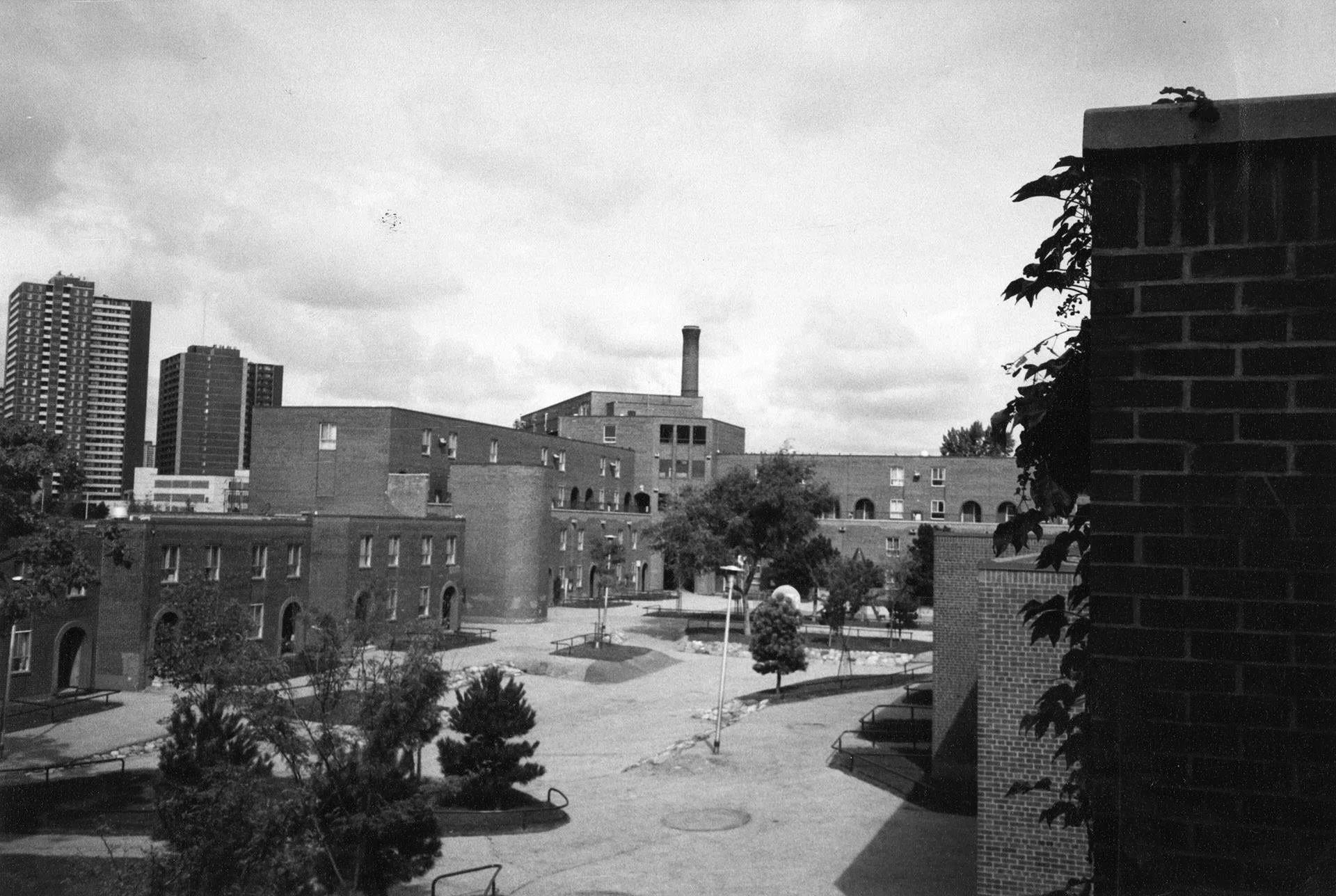
Don Mount Court Apartments -- Courtesy of Toronto Public Library -- 1984
DD: Aretha has an obsession with where she needs to be and what it looks like. There’s a reason the house is mentioned so often. It very much ties back to her grandmother’s belief in how important it is to have a house. Coming out of slavery, being able to own property was a big deal. For Aretha, that dream became like a sore.
DBN: What constitutes home is a major theme in the novel. Talk to me about the evolution of home in the novel.
DD: Home is a big deal. It dilutes as one migrates. It stays back across the water. But what does that mean for us if we are not at home?
DBN: I love the way you write about what makes Don Mount home; the experiences that accumulate around a place when you become part of it.
DD: I feel like every writer has a mission. Home is my lane. I think it’s because I was born here, but my parents moved to Jamaica when I was three. I went to a private Seventh Day Adventist school. And there were other Canadians there. Our parents had the notion that the Canadian education system was not good for us. And then I came back to Canada.
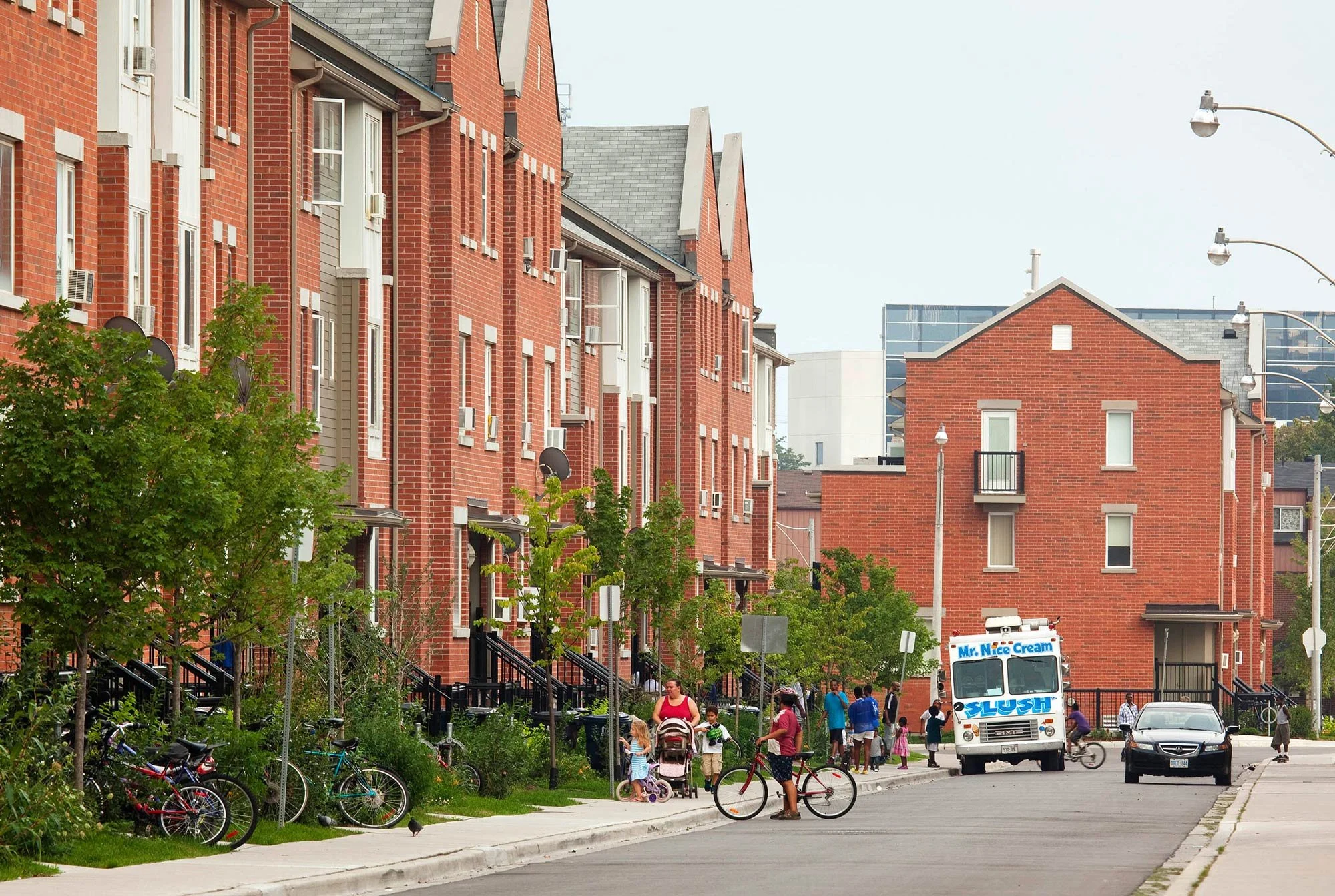
Don Mount Court Apartments after gentrification
DBN: How does that experience impact your idea of home?
DD: Place is key to identity- your nationality, your citizenship, your language. That’s the macrocosm. Then you’ve got the microcosm: where you live and how to survive in a particular neighbourhood. Sometimes you’ve got to disguise yourself to survive, for better or for worse. A lot of people do that, and we pay no attention to it. Delia learns you must reconcile who you are with where you live, but not let it define you. Aretha fights against this tooth and nail- to the point that her actual home – the inside of the house- becomes poisonous.
DBN: How did you become a writer.
DD: I always loved writing. When I was in high school, English classes and art classes dominated my curriculum. I wrote in a notebook at the time, and I hand wrote a story about the people in my school. I passed it around. I remember my friends being so enthusiastic about being in a story. We had never had the privilege of reading material that made us feel like we were seen. We were Caribbean descendants and about half of us lived in housing. There was a sense that our lives were a secret just to us.
DBN: When did you begin writing this novel?
DD: I was sitting at a receptionist desk, and it was not where I wanted to be. I was bored out of my mind. I pulled up a little computer and I started writing the story at work. It was when communications started about Don Mount housing in Toronto being demolished (2002). A picture of the demolition is on the cover of the book.
DBN: Why did you choose to write about Don Mount?
DD: I stayed there for summer when I was 13. I had family that lived there. I was trying to recapture that summer in my mind. I knew that when it was gone, nobody would care enough to record what it had meant to the people who lived there. It wasn’t my home. But somewhere in my heart, it was my home.
This video interview took place August 7, 2024. It has been edited for space and clarity.